
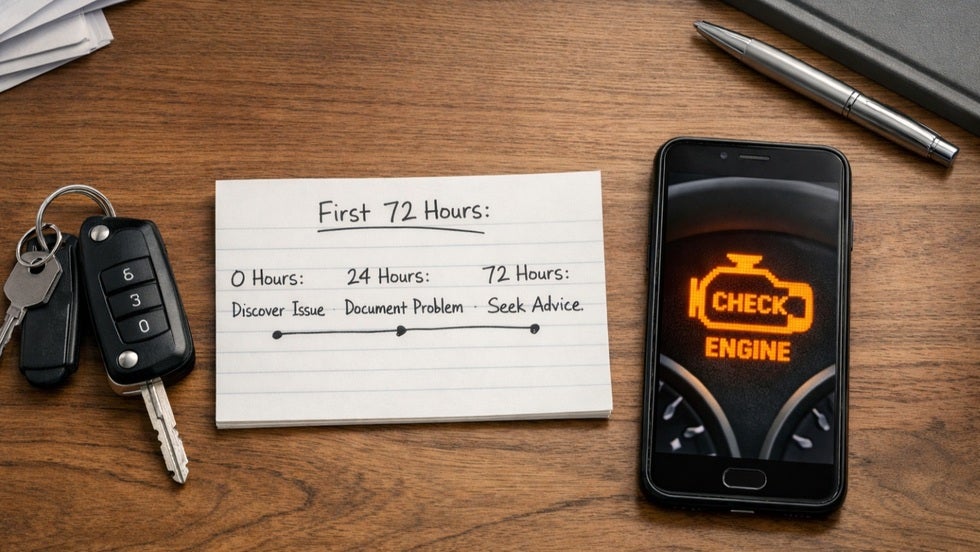
When a serious problem shows up right after a used car purchase, most people lose leverage in the same way. They wait, argue by phone, or keep driving until the story gets blurry.
The goal in the first 72 hours is simple:
- Lock in a clean timeline
- Preserve the evidence you already have
- Avoid mistakes that make the situation harder to prove later
This checklist is the action plan. For the “why” behind key steps, it links back to our posts 1, 2, 3, and 4.
The first 15 minutes: freeze the facts
Do these right away:
- Write down the date and mileage when the problem first appeared
- Write down what the symptom is, in plain words
- Save a screenshot of the listing if you can still access it
- Save the seller's name, address, salesperson's name, and any phone numbers
- Save texts and emails as originals, do not rewrite them
If the car feels unsafe, stop driving it.
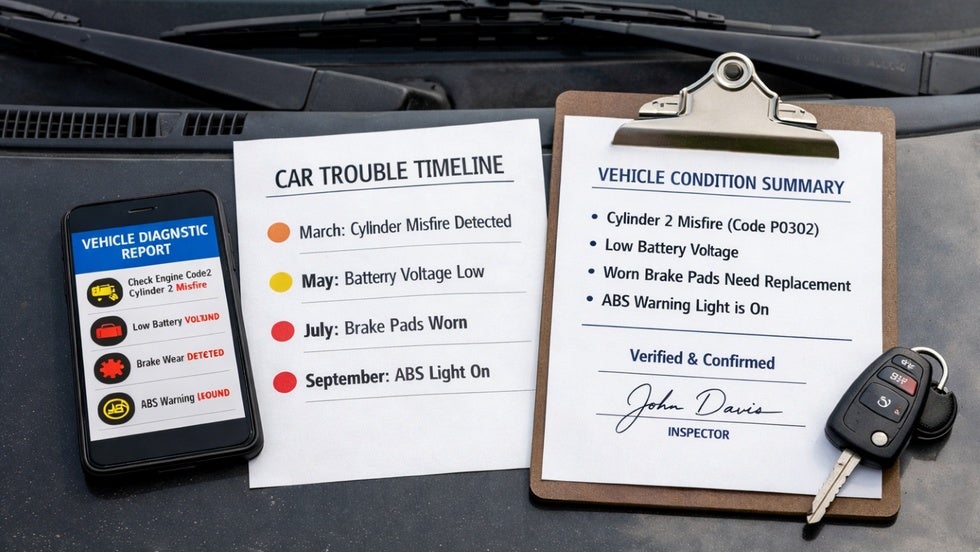
Day 1: capture proof you can actually use
Get a basic diagnostic record
If a warning light is on, get a code readout as soon as practical:
- A shop printout is ideal
- A photo of a scan screen is still helpful
- Write down the mileage at the time of the scan
Do not clear codes yourself. It can wipe useful information.
Create a simple timeline
Keep it short and factual:
- Purchase date and mileage
- What you were told at sale that mattered to your decision
- When the issue appeared
- What happened next
- What the dealer said when you reported it
Confirm your key facts in writing
If you call the dealer, follow up with an email that confirms:
- The problem you reported
- The date you reported it
- Their response or refusal
You are not escalating. You are creating a record.
Day 2: check the paperwork for two issues that change the strategy
Issue 1: arbitration clause
Look for “Arbitration” or “Dispute Resolution” in:
- Retail installment contract if financed
- Buyer's order or purchase agreement
- Any separate arbitration agreement
This matters because it changes the forum and the timeline.
Issue 2: fees and add-ons that did not match what you understood
Pull out anything you received at signing and identify:
- Doc fee, prep fee, admin fee
- Add-ons like protection packages, etching, tracking, service plans
- Any price changes from what you expected
If you do not have copies, request them in writing.
Day 3: choose a clean communication approach
If you are going to contact the dealer again, keep it short and specific:
- Ask for their position in writing
- Ask if they will repair, unwind, or deny
- Ask for any inspection or reconditioning checklist
- Ask for repair orders for any work done before sale
Avoid long phone arguments. You want documentation, not drama.
One table to keep this simple
|
Action step |
Why it matters |
Read more |
|
Save the listing and messages |
Ads and written claims reduce “he said she said” |
Post 1: As Is and what it really means |
|
Identify fees and add-ons line by line |
The mismatch is often hidden in late stage paperwork |
Post 2: Hidden fees and add-ons |
|
Do not clear codes, get diagnostics early |
Timing and OBD records can show the issue existed at sale |
|
|
Check for arbitration clause early |
It changes the path, timelines, and what to prepare |
Post 4: Arbitration clauses explained |
|
Keep dealer communication in writing |
A written record is harder to deny later |
All posts: especially 1 and 4 |
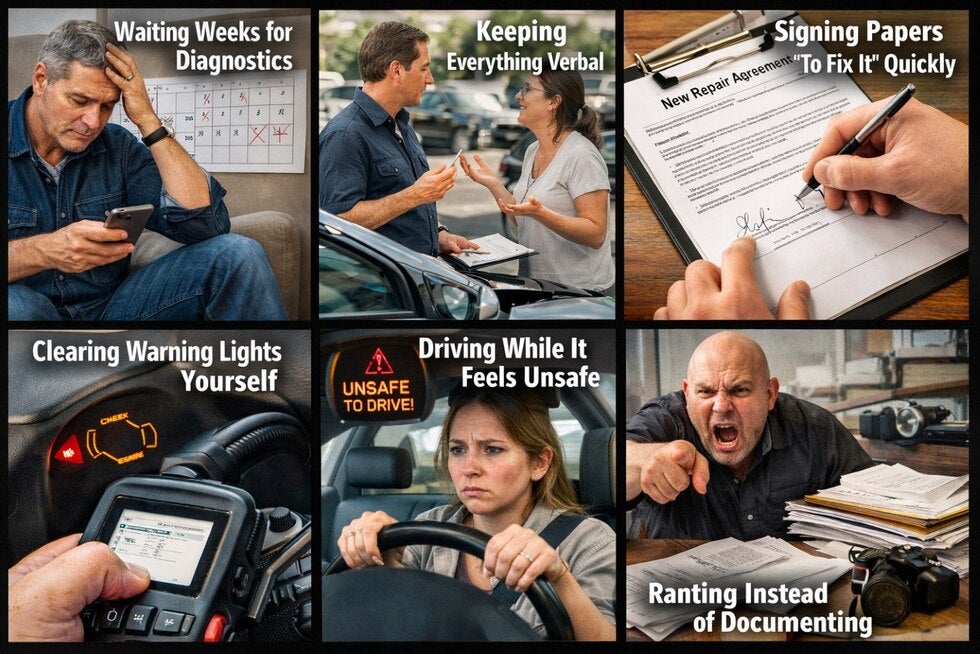
Common mistakes that cost people leverage
- Waiting weeks to get diagnostics
- Letting everything stay verbal
- Signing new paperwork “to fix it” without clarity
- Clearing warning lights or codes yourself
- Continuing to drive a vehicle that feels unsafe
- Focusing on anger instead of documentation
Case Reality Check (Free)
If you are dealing with a similar problem, start by summarizing the basics in the contact form. That lets us understand the situation before we speak, so the call is focused.
Case Reality Check (Free): After we read what you submit, we will email you, set a quick 10 to 15 minute call to ask a few qualifying questions, give you our straight take, strong, weak, or borderline, and explain the most sensible next step.
How to start:
In the contact form, tell us the vehicle, purchase date, what went wrong, when it started, what the dealer said, and whether there were warning lights, surprise fees, or an arbitration clause. We will reach out by phone or email with an initial assessment, usually within 1 to 2 business days.
FAQ
Do I really need to act within 72 hours?
You do not need to solve everything in 72 hours. The goal is to preserve the timeline and capture key proof while it is fresh.
What should I do first if the car feels unsafe?
Stop driving it and document what happened. Write down the date, mileage, and symptoms. If a warning light is on, get a diagnostic readout as soon as practical.
What if I cannot get diagnostics immediately?
Start with what you can do now. Save the listing if you can, save messages, write a short timeline, and contact the dealer in writing. Then get diagnostics as soon as practical.
Should I clear the check engine light or codes?
No. Clearing codes can wipe useful information. Capture the codes and mileage first.
What if the dealer says the sale was as is and refuses to help?
Ask for that position in writing. Then focus on documentation, what was represented, what changed right after purchase, and what can be proven.
What if I discover surprise fees or add ons after signing?
List the fees and add ons you did not expect, and ask the dealer in writing to confirm what each charge is for and where you agreed to it.
What if the contract requires arbitration?
Arbitration usually changes the forum and procedure. Gather the full contract set, keep your records organized, and document everything early.
You may also like:
- Used Car Fraud & “As-Is” Dealer Misrepresentation
- Does “As-Is” Mean You’re Stuck? What It Does and Doesn’t Mean in Used Car Sales
- Hidden Fees and Add-Ons in Used Car Deals: How to Spot the Mismatch
- Cleared Warning Lights and Masked Defects After a Used Car Sale
- Arbitration Clauses in Used Car Contracts: What Changes and What to Prepare

Comments
There are no comments for this post. Be the first and Add your Comment below.
Leave a Comment