
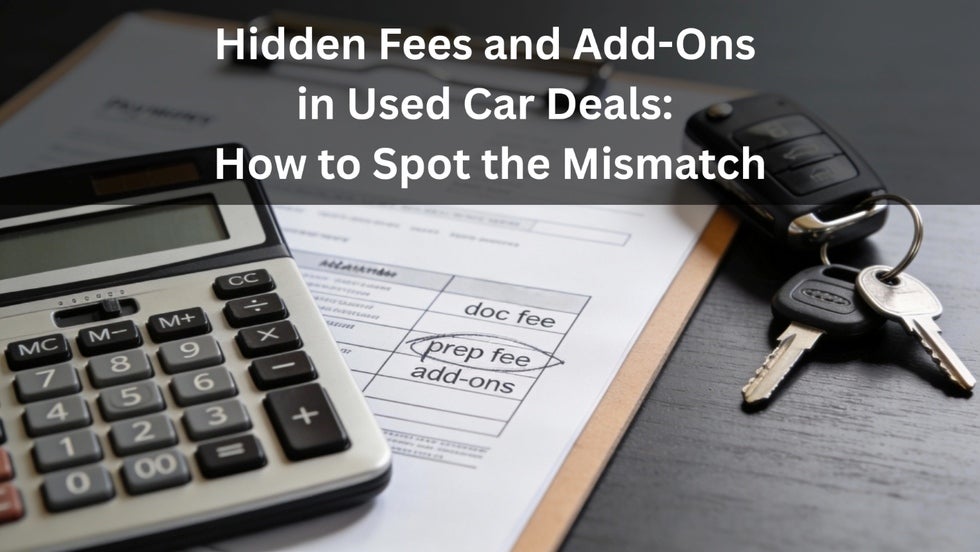
You go in for a car you can afford. The listing price looks reasonable. Then you're in the finance office staring at a different number (loaded with “doc,” “prep,” and “protection” charges you didn't expect).
Sometimes fees are normal. Sometimes they're a problem.
This post is about one thing: how to recognize when the paperwork doesn't match what you were sold, and what you should ask for in writing before you sign.
If you want the big-picture overview of used-car fraud and “as-is” misrepresentation – read our main guide on this topic.
The core mismatch that matters
Most fee/add-on disputes come down to a simple contradiction:
- You thought you were agreeing to Price A
- The signed documents lock in Price B
- And the gap is explained with vague line items that weren't clearly disclosed upfront
That gap is where people get squeezed.
Not because buyers don't read. Because the deal often changes late, after time pressure kicks in:
- “We already ran your credit”
- “The car won't be here tomorrow”
- “This is standard, everyone pays it”
- “Just sign and we'll fix it later”
If anything about the deal is “fix it later,” treat that as a flashing warning light.

The fee buckets (what you're actually looking at)
A clean deal usually separates costs into clear categories. A messy deal blurs them.
1. Legitimate transaction costs (the ones you expect)
These often include taxes and government-related title/registration costs. The exact names and amounts vary, but they should look familiar and be consistent across documents.
2. Dealer fees (where the padding often lives)
Common labels include:
- Doc fee (documentation fee)
- Prep fee / Reconditioning
- Delivery / Conveyance
- Administrative fee
A dealer fee can be disclosed and still feel annoying. That alone doesn't make it fraud.
What raises concern is when the fee:
- appears late
- changes size
- is described one way verbally and another way in writing
- is paired with an “it's mandatory” claim without any clear disclosure
3. Add-ons (where “optional” becomes “mandatory”)
Common add-ons include:
- paint/interior “protection”
- VIN etching / theft protection
- nitrogen tires
- key replacement programs
- LoJack / GPS / tracking
- wheel and tire coverage
- service contracts / extended warranties
- GAP coverage (often tied to financing)
Again, some buyers actually want some of these.
The issue is how they're sold:
- slipped in without clear consent
- presented as required when it's really optional
- priced in a way that wasn't disclosed before the paperwork
- or bundled so you can't tell what you're paying for
Red flags that the deal is being “loaded”
If two or more of these are happening, slow everything down.
- You can't get an out-the-door number until the last minute
- The salesperson keeps talking in monthly payment only, not total price
- You're told an add-on is mandatory, but nobody can show it clearly in writing
- The buyer's order is rewritten multiple times and you're asked to “just initial here”
- You feel rushed to sign because “the lender is waiting”
- You're not given copies of what you signed immediately
- The advertised price only applies if you buy “packages” you never asked for
- A “discount” appears, then disappears through new fees
Rule of thumb: if the price is real, they should be able to print it.

What to request (and what should be in writing)
If you take nothing else from this post, take this:
Ask for a written out-the-door breakdown before you sign
You want a single page (or email) that lists:
- vehicle price (sale price)
- taxes and title/registration estimates
- doc/admin fees (clearly labeled)
- each add-on (each one named and priced)
- down payment
- trade allowance and trade payoff (if any)
- amount financed and total due at signing
If they won't provide that, you're negotiating in the dark.
For add-ons, demand three things in writing
- What it is (plain description)
- What it costs (separate line item)
- Whether you can decline it (yes/no)
If it's “mandatory,” your follow-up question is simple:
“Where is that disclosed in writing?”
Not argued. Not emotional. Just: show me.
If a salesperson promises something, put it on the “We Owe” (or equivalent)
If they say:
- “We'll remove that fee”
- “We'll cancel that add-on”
- “We'll fix those scratches”
- “We'll include new tires”
- “We'll re-do the paperwork”
Then the correct response is:
“Great, please put that in writing on the We Owe / due bill”
If it's not in writing, assume it may not happen.
Two scripts that save buyers money
You don't need a speech. You need one clean sentence.
Script 1: The out-the-door anchor
“Before I sign anything, please print the out-the-door breakdown with every fee and add-on listed.”
Script 2: The “mandatory” challenge
“If it's mandatory, please show me where it's disclosed in writing. If it's optional, I'm declining it.”
If they can't answer that without pressure tactics, you have your answer.
If you already signed and discovered fees/add-ons afterward
This happens constantly, especially when the buyer only sees the full breakdown later.
Here's the practical checklist:
Step 1: Compare three numbers
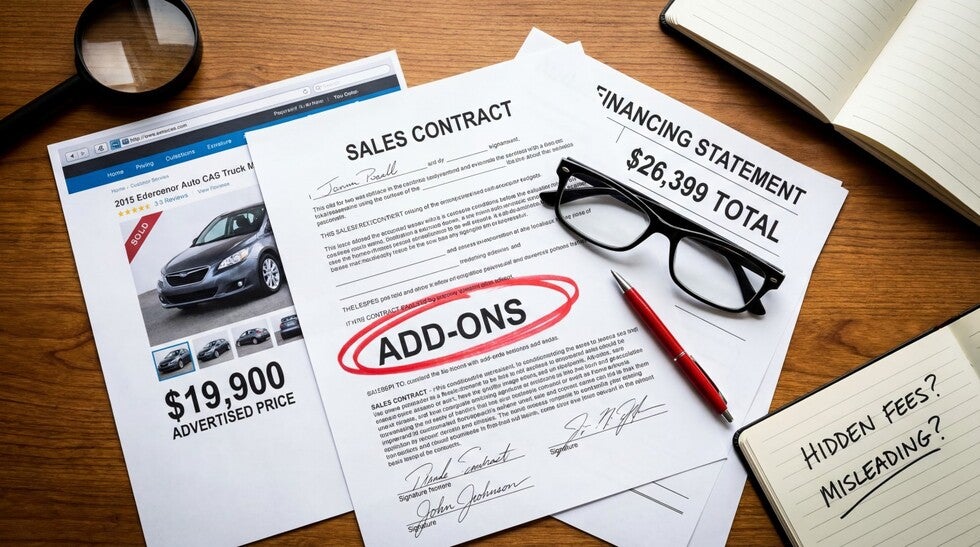
- the advertised/listing price (screenshot it if you still can)
- the buyer's order / purchase agreement price
- the amount financed (if you financed)
If the amount financed is far above what you expected, the gap usually comes from fees, add-ons, negative trade equity, or both.
Step 2: Identify every add-on you didn't knowingly choose
Look for line items you don't recognize, and for bundled descriptions that don't say what you're paying for.
Step 3: Get clarity in writing
Ask the dealer (in writing) to confirm:
- which add-ons were included,
- the price of each,
- and where you agreed to them.
Short, direct requests are harder to dodge.
Step 4: Don't let the conversation stay verbal
If the dealer calls, you can keep it simple:
“Please email your response so I have it in writing”
Documentation is not aggression. It's self-protection.
Case Reality Check (Free)
If you're seeing questionable fees, late-stage add-ons, or a bait-and-switch style pricing change, start by summarizing the basics in the contact form. That lets us review the situation first, so the call can focus on the few details that matter most.
Case Reality Check (Free): After we read what you submit, we'll email you, set a quick 10–15 minute call to ask a few qualifying questions → give you our straight take (strong, weak, or borderline) and the most sensible next step.
How to start:
In the contact form, tell us the vehicle, purchase date, what went wrong, and what you were told at the sale. We'll reach out by phone or email with an initial assessment, usually within 1–2 business days.
FAQ
Are doc fees and prep fees always illegal?
Not automatically. The issue is usually disclosure and deception – what you were told, what was shown in advertising, and what the documents actually lock in.
The dealer said the add-on was mandatory. Is that true?
Sometimes it's presented that way to prevent you from declining it. The practical move is to ask: “Where is that disclosed in writing?” If they can't show it, treat it as optional unless proven otherwise.
What if the dealer refuses to give an out-the-door price in writing?
That's a major red flag. A real deal can be printed. If you can't get a written breakdown, you can't meaningfully compare offers or catch padded line items.
I only negotiated monthly payment. Did I mess up?
Not necessarily, but payment-only negotiations make it easier to hide cost. Ask for the full breakdown and compare total price, add-ons, and amount finance
What if this is really a bait-and-switch situation?
If the advertised price disappears in the finance office, or the deal changes through surprise fees/add-ons, that can fit a bait-and-switch pattern. We have a separate page that goes deeper on that tactic.
You may also like:
- Used Car Fraud & “As-Is” Dealer Misrepresentation
- Does “As-Is” Mean You’re Stuck? What It Does and Doesn’t Mean in Used Car Sales
- Cleared Warning Lights and Masked Defects After a Used Car Sale
- Arbitration Clauses in Used Car Contracts: What Changes and What to Prepare
- Used Car Fraud Checklist: What to Do in the First 72 Hours

Comments
There are no comments for this post. Be the first and Add your Comment below.
Leave a Comment